Thursday, June 1, 2017

Google's CEO Doesn't Use Bullet Points and Neither Should You

Google's CEO Doesn't Use Bullet Points and Neither Should You


Google's Sundar Pichai gives a master class for creating simple, engaging presentations.


9 COMMENTS
Sundar Pichai.
 
CREDIT: Getty Images
Google CEO Sundar Pichai recently announced at the company's 2017 developers conference that Google is "rethinking all our products" as it moves from a mobile-first world to an "A.I.-first" one. His presentation also reflected a rethinking of traditional presentation style.
Senior managers and executives at Google have told me that visual storytelling plays an important role in getting their messages across. In fact, Google's employees are being trained to present in a bolder, fresher style--less text heavy and more visual.
"Since stories are best told with pictures, bullet points and text-heavy slides are increasingly avoided at Google," Pichai said at the conference. His slides were remarkably uncluttered. The first thing you noticed in his presentation was the large amount of white space on each slide. Just as professional ad designers avoid filling up an entire page with text, Pichai didn't clutter his slides with extraneous words or numbers.
One researcher concludes that the average PowerPoint slide contains 40 words. From the beginning of Pichai's presentation, it took about 12 slides to reach 40 words. The slides were mostly photos and animations. When text did appear, it showed up as a few words to describe the photo or image.
For example, Pichai's first slide had seven logos for Google's primary products (Search, YouTube, Android, etc.) and the following text: "1 Billion+ Users." The point of the slide was to explain that Google's products each attract more than 1 billion monthly users.

The brain can't do two things at once

Pichai and Google's slide designers are creating brain-friendly presentations. Cognitive scientists say it's impossible for us to multitask as well as we think we can. The brain cannot do two things at once and do them equally well. When it comes to presentation design, we can't read text on the screen and listen to the speaker while retaining all of the information. It can't be done.
University of Washington biologist John Medina has done extensive research into persuasion and how the brain processes information. His advice is to burn most PowerPoint decks and start over with fewer words and more pictures. According to his book, Brain Rules, "We are incredible at remembering pictures. Hear a piece of information, and three days later you'll remember 10 percent of it. Add a picture and you'll remember 65 percent."
If you want to create visually interesting slides, less is more. Slide design guru Nancy Duarte recommends following a three-second rule. If viewers do not understand the gist of your slide in three seconds, it's too complicated. "Think of your slides as billboards," says Duarte. "When people drive, they only briefly take their eyes off their main focus, which is the road, to process a billboard of information. Similarly, your audience should focus intently on what you're saying, looking only briefly at your slides when you display them."
When is the last time you saw a billboard with a bullet-point list? Bullet points are the easiest design to create on a PowerPoint slide and the least effective.
In his book TED Talks, Chris Anderson writes, "Those classic PowerPoint slide decks with a headline followed by multiple bullet points of long phrases are the surest single way to lose an audience's attention altogether.... When we see speakers come to TED with slide decks like this, we pour them a drink, go and sit with them at a computer monitor, and gently ask their permission to delete, delete, delete."
According to Anderson, each bullet point becomes its own slide. A bullet point might become one sentence on a slide or be replaced entirely with a photo. In Pichai's Google presentation on A.I., slide number five carried the theme. There were five words on the slide: "Mobile first to A.I. first."
Pichai's slide obeyed the TED rule--delete, delete, delete. It works for Google. It will work for you.

Bill Gates has a message for every college grad who wants to change the world

Bill Gates has a message for every college grad who wants to change the world

Dear Class of 2017:
Congratulations! You’ve just accomplished something I never managed to do — earn a college degree.
Between your commencement speaker and every aunt and uncle at your graduation party, I am sure you are getting a lot of advice. At the risk of piling on, I thought I would share a few thoughts.
New college graduates often ask me for career advice. I was lucky to be in my early 20s when the digital revolution was just getting underway, and Paul Allen and I had the chance to help shape it. (Which explains my lack of a college degree: I left school because we were afraid the revolution would happen without us.) 
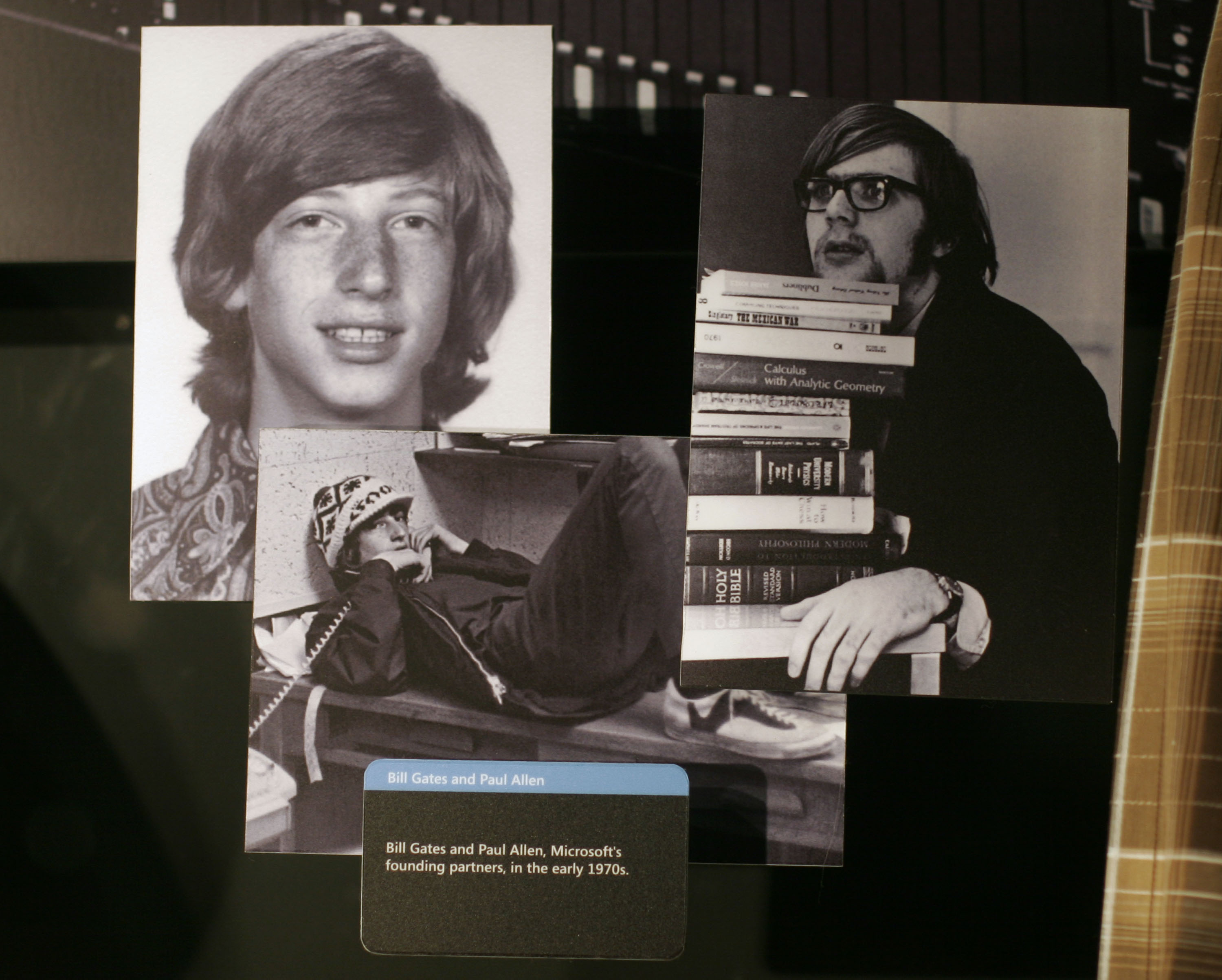
Pictures of Microsoft cofounders Bill Gates (left) and Paul Allen in the early 1970s are on display at the Microsoft Visitor Center in Redmond, Washington.
Source: Ron Wurzer/Getty Images
If I were starting out today and looking for the same kind of opportunity to make a big impact in the world, I would consider three fields.
One is artificial intelligence. We have only begun to tap into all the ways it will make people’s lives more productive and creative. 
The second is energy, because making it clean, affordable and reliable will be essential for fighting poverty and climate change. 
The third is biosciences, which are ripe with opportunities to help people live longer, healthier lives.
But some things in life are true no matter what career you choose. I wish I had understood these things better when I left school. For one thing, intelligence is not quite as important as I thought it was, and it takes many different forms. 
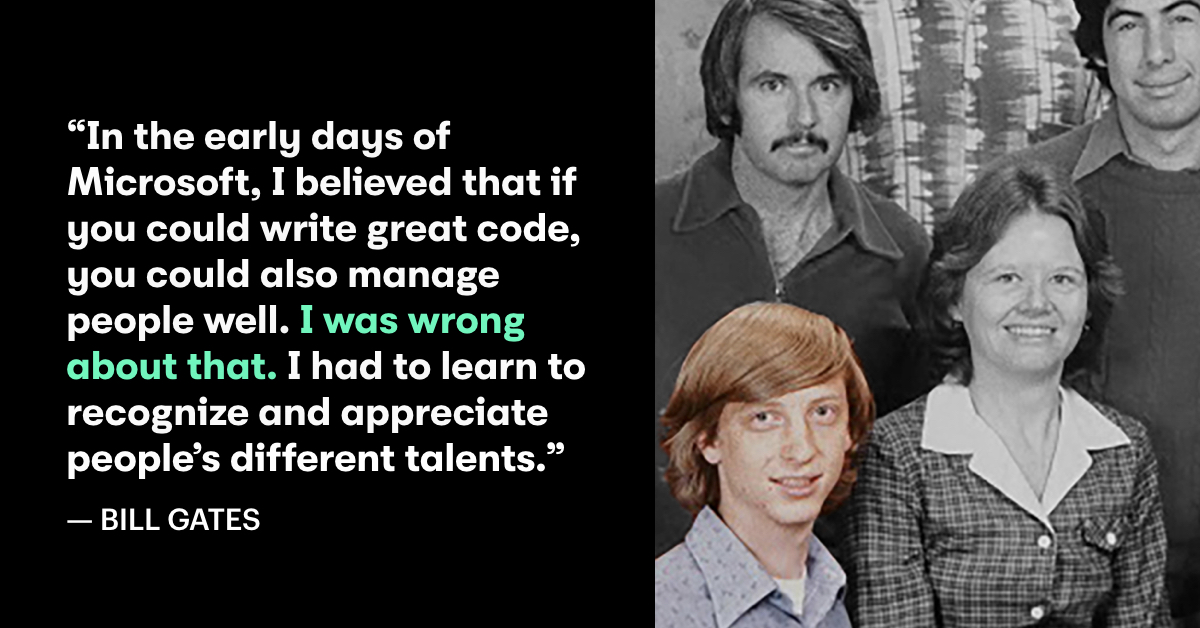
Gates with the Microsoft staff in 1978.
Source: Mic/Wikimedia Commons
In the early days of Microsoft, I believed that if you could write great code, you could also manage people well or run a marketing team or take on any other task. I was wrong about that. I had to learn to recognize and appreciate people's different talents. The sooner you can do this, if you don’t already, the richer your life will be.
Another thing I wish I had understood much earlier is what true inequity looks like. I did not see it up close until my late 30s, when Melinda and I took our first trip to Africa. We were shocked by what we saw. When we came back, we began learning more. It blew our minds that millions of children there were dying from diseases that no one in rich countries even worried about. We thought it was the most unjust thing in the world. We realized we couldn’t wait to get involved — we had to start giving back right away.
You know much more than I did when I was your age. Technology lets you see problems in ways my friends and I never could, and it empowers you to help in ways we never could. You can start fighting inequity sooner, whether it is in your own community or in a country halfway around the world.
Meanwhile, I encourage you to surround yourself with people who challenge you, teach you and push you to be your best self. Melinda does that for me, and I am a better person for it. Like our good friend Warren Buffett, I measure my happiness by whether people close to me are happy and love me, and by the difference I make in other people's lives.
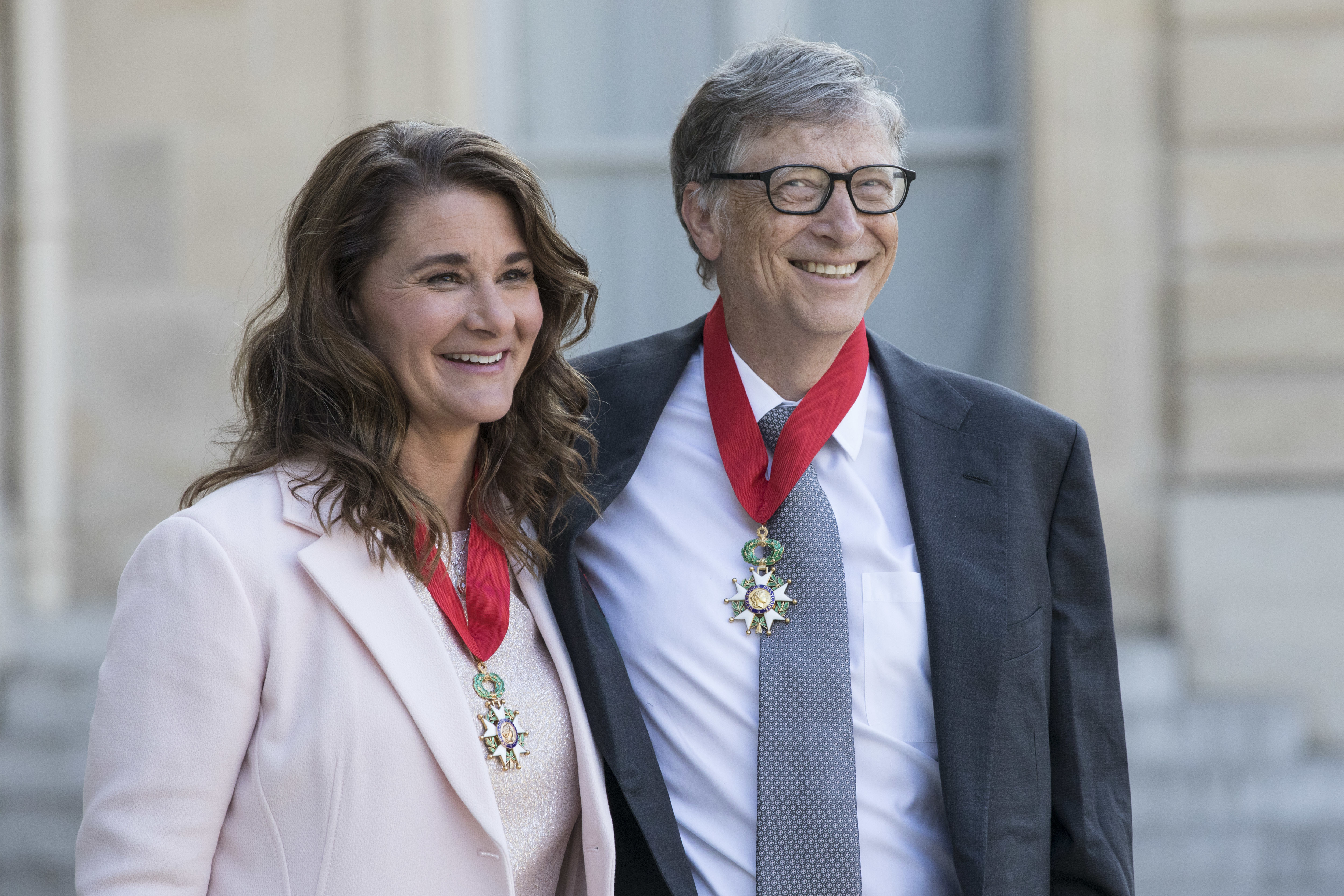
Bill Gates (right) and wife Melinda Gates receive France's Legion of Honour on April 21, 2017, at the Elysee Palace in Paris.
Source: Kamil Zihnioglu/AP
If I could give each of you a graduation present, it would be a copy of The Better Angels of Our Nature by Steven Pinker. After several years of studying, you may not exactly be itching to read a 700-page book. But please put this one on your reading list to get to someday. It is the most inspiring book I have ever read.
Pinker makes a persuasive argument that the world is getting better, that we are living in the most peaceful time in human history. This can be a hard case to make, especially now. When you tell people the world is improving, they often look at you like you're either naive or crazy.
Source: Mic/Getty Images
But it's true. And once you understand it, you start to see the world differently. If you think things are getting better, then you want to know what’s working so you can accelerate the progress and spread it to more people and places.
It doesn’t mean you ignore the serious problems we face. It just means you believe they can be solved, and you’re moved to act on that belief.
This is the core of my worldview. It sustains me in tough times and is the reason I still love my philanthropic work after more than 17 years. I think it can do the same for you.
Good luck to all of you. This is an amazing time to be alive. I hope you make the most of it.
Bill Gates
Bill Gates is co-chair of the Bill & Melinda Gates Foundation. In 1975, Bill Gates founded Microsoft with Paul Allen and led the company to become the worldwide leader in business and personal software and services. In 2008, Bill transitioned to focus full-time on his foundation’s work to expand opportunity to the world’s most disadvantaged people. Along with co-chair Melinda Gates, he leads the foundation’s development of strategies and sets the overall direction of the organization. In 2010, Bill, Melinda and Warren Buffett founded the Giving Pledge, an effort to encourage the wealthiest families and individuals to publicly commit more than half of their wealth to philanthropic causes and charitable organizations during their lifetime or in their will.

Silicon Valley has idolized Steve Jobs for decades—and it’s finally paying the price

Silicon Valley has idolized Steve Jobs for decades—and it’s finally paying the price

But he’s also the same man who would allegedly yell at people for 30 minutes straight, cut in front of his employees at lunchtime, berate hospitality and restaurant staff, park in handicapped spaces, said all HR personnel have a “mediocre mentality,” and told his staff how much they “sucked.”
Whether it’s the 19th-century railroad industrialist George Pullman or Mr. Spacely from The Jetsons, CEOs have always been a surly bunch. But in recent years, it seems that being an asshole has become an aspirational trait.
It’s no wonder. Walter Isaacson’s biography Steve Jobs didn’t just create a Hollywood hit: It created a manual for any bosses seeking a hall pass for their temper tantrums. Along with recounting Jobs’s blistering behavior and his “perverse eagerness” for putting people down, Isaacson remarks that “people who were not crushed ended up being stronger” and that those employees who were most abused by Jobs ended up accomplishing things “they never dreamed possible” thanks to his harsh treatment.
In other words, it’s okay to tell your employees that their work is shit and to park your Mercedes across two handicapped parking spaces—as long as the end result is a successful product.
No wonder we now have people like Uber CEO Travis Kalanick and Amazon CEO Jeff Bezos making numerous headlines for their tempestuous behavior. Several Uber executives have left the company, while investors have publicly criticized Kalanick, saying that there are “toxic patterns” in the Uber workplace. Meanwhile, Amazon has a reputation for being a “bruising workplace,” the kind of office where people regularly break down at their desks, and where grown men leave the conference room with their faces covered to hide their tears.
It’s no wonder. Walter Isaacson’s biography Steve Jobs didn’t just create a Hollywood hit: It created a manual for any bosses seeking a hall pass for their temper tantrums. Along with recounting Jobs’s blistering behavior and his “perverse eagerness” for putting people down, Isaacson remarks that “people who were not crushed ended up being stronger” and that those employees who were most abused by Jobs ended up accomplishing things “they never dreamed possible” thanks to his harsh treatment.
In other words, it’s okay to tell your employees that their work is shit and to park your Mercedes across two handicapped parking spaces—as long as the end result is a successful product.
No wonder we now have people like Uber CEO Travis Kalanick and Amazon CEO Jeff Bezos making numerous headlines for their tempestuous behavior. Several Uber executives have left the company, while investors have publicly criticized Kalanick, saying that there are “toxic patterns” in the Uber workplace. Meanwhile, Amazon has a reputation for being a “bruising workplace,” the kind of office where people regularly break down at their desks, and where grown men leave the conference room with their faces covered to hide their tears.
Somewhere along the way, it seems that Silicon Valley decided that internet connectivity matters more than human connectivity; that a surfeit of technical intelligence can make up for a dearth of emotional intelligence. After all, if it worked for a genius like Jobs, it can’t be that bad.
Except it is. While this management style might work in the short-term, employees can’t flourish for long under a narcissistic, demanding boss. As recounted in the Isaacson’s biography, Jobs’s acid tongue eventually caused his employees to burn out. After working 10 months of 90-hour workweeks, one employee finally quit in exasperation after Jobs walked into the room and told everyone how “unimpressed” he was with what they were doing. Apple co-founder Steve Wozniak said “some of the most creative people in Apple who worked on the Macintosh” left the company and refused to ever again work for Jobs again. Because of Jobs’ nasty temper, Apple lost out on impressive talent.
New research bears out these experiences. Studies have shown that hyper-critical leadership not only leads to unmotivated employees and office in-fighting but can also lead to serious issues like depression, high blood pressure, weight gain, substance abuse, and even premature death.
But can we really blame Jobs for this legacy of emotionally lethal (and perhaps literally lethal) work environments?
“Managers who try to emulate Mr. Jobs by just being rude or aggressive are missing the point,” Issacson says. “Mr. Jobs was striving for perfection.” But within this justification lies the problem. Of course Jobs wanted perfection—all CEOs do. But why is bullying considered an effective, let alone acceptable, way to motivate your team to perfection? Jobs was famous for the way he would obliterate his staff, often in public, which maximized their humiliation by making it a spectacle rather than a private affair. Are we to believe that shaming employees is what made Apple great?
Recent research on shame and the devastating impact it can have on a person’s motivation, creativity, and behavior would say otherwise. Shame has been linked to depression, alcoholism, obesity, violence, and even recidivism in inmates. As author and shame researcher Brené Brown says, “Shame corrodes the very part of us that believes we are capable of change.”
It’s simple: The worse we feel about ourselves as people, the less we are able to make good choices and perform to our highest potential. Making your employees feel terrible about themselves isn’t just an ineffective leadership tool: It’s also just plain lazy. It takes no special skill to scream at someone, and it’s easy to lash out when you are angry or disappointed. But to lead with dignity, composure, kindness, and self-awareness? That takes effort. That takes maturity. And it doesn’t come naturally to most of us.
Whether or not it comes easily, emotional intelligence ought to be the foremost requirement for our companies’ leaders. These skills can be taught, CEOs can change, and we can demand better. A boss in Silicon Valley who isn’t an asshole? Now that would be “thinking different.”

Want Your Best Employees to Never Leave You? Ask Them 5 Simple Questions

Want Your Best Employees to Never Leave You? Ask Them 5 Simple Questions

Most importantly, leaders should be asking these questions before their best people mentally and emotionally check out.

 
WRITE A COMMENT
CREDIT: Breather via Unsplash
Want to do something that will launch you into the new era of HR? Get rid of your exit interviews and replace them with "stay interviews."
If you're new to this concept, unlike the exit interview, managers are using stay interviews to get fresh insight into improving the work environment or their own leadership skills to retain those valued employees today--not after they have emotionally disconnected and stopped caring.
Fair warning: Stay interviews are only as effective as people's willingness to demonstrate transparency. The whole premise is based on honest two-way conversations between manager and employee, where each side gets to listen, ask questions, and agree to follow up on ideas and action plans.
Webroot Software, a 400-employee internet security company, implemented stay interviews right after a reduction in their work force. Their HR director, Melanie Williams, says, "the information collected by stay interviews is more actionable than secondary source information because it's specific and forward-facing."
The stay interview builds trust with employees, who feel valued because leaders are sending the message that they see them as important and want to get a feel for what's working and not working for them. And then doing something about it.

The 5 Questions

Here's what to do: Make stay interviews questions simple and informal when meeting with direct reports one-on-one. Here are five "must asks" to ensure winning back unhappy employees who are key to your operation's success.

1. "What do you like about your job?"

This question sets a positive tone to assess their work satisfaction and helps a manager clue in to what parts of the job employees like and want to experience more of.

2. "Could you describe a good day of work you had recently?"

Tap into their memories to extract clear and specific examples of positive experiences they've had. Leaders should be asking this question to learn everything they can about replicating the experience so that every day looks more like it.

3. "Do you feel your skills are being utilized to the fullest?"

Best case scenario here is discovering that the employee has skills the company or leader never knew about, which is a win-win: The employee wins by using personal strengths that raise personal motivation and engagement; the leader wins by offering new opportunities to tap into those strengths, which releases discretionary effort that will benefit the company, project, or team.

4. "Do you feel you get properly recognized for doing good work?"

A leader will gauge frustration levels by courageously asking this question and openly accepting the response and, if it's negative, brainstorming solutions together. As Gallup has observed in its extensive research, praise and recognition for accomplishments have been repeatedly linked to higher employee retention. How regularly are we talking? Praise should be given once per week.

5. "Do you feel like you are treated with respect?"

Leaders should ask this question to determine the health of the team. Is there blame traveling in different directions, and are people pointing fingers at each other? Are there silos, heavy politics, stonewalling, or people being thrown under the bus? These toxic behaviors suggest a total lack of mutual respect as a cultural trait. Studies show respect is a key driver in overall employee engagement, and its absence as a contributor to employees leaving.