Friday, December 29, 2017

Good questions for end of interview

 What is the most important personality trait common among your top performers?

What would you expect the person in this position to do in the first 90 days to be considered successful?

What challenges do you foresee down the pike in the next 60 to 90 days?

What is someone with my experience expected to complete in year one?


Wednesday, December 27, 2017

12 Things Successful People Do On Friday Afternoons

12 Things Successful People Do On Friday Afternoons

Oct. 14, 2016

Start your weekend off right

How you end your workweek will not only have a huge impact on how productive you are the following week, but also may determine how relaxed you are over the weekend.
“Successful people tend to adhere to routines in general, so it’s no surprise that the mostsuccessful people I know maintain a Friday afternoon routine,” says Michael Kerr, an international business speaker and author of “The Humor Advantage.”
Here are 12 things successful people typically do on a Friday afternoon:
1. They reflect on their accomplishments from the weekIt’s far too easy to wallow over what you didn’t accomplish, Kerr says. “Successful people tend to flip that around and remind themselves of just how much progress they did make, even if it’s only ‘small wins.'” Acknowledging and appreciating your accomplishments not only boosts your happiness levels, but it fuels momentum. “A great ritual for team leaders to create is to turn this into a Friday afternoon team huddle tradition, wherein everyone shares their top three accomplishments for the week,” Kerr suggests.
2. They figure out their priorities for the following weekSuccessful people take time on Friday afternoon to reflect on their professional and personal lives and determine three to five major priorities they want to accomplish for each, says Laura Vanderkam, author of “What the Most Successful People Do Before Breakfast” and “I Know How She Does It.”
3. They establish a schedule and to-do list for the following weekThey don’t just prioritize; they plan, Vanderkam says. “If you assign each priority a deadline, things are likely to get done. You want to hit Monday morning knowing what you need to do, so you’re not wasting that time figuring this out.” Having a plan for Monday also results in a more relaxed weekend, she adds. “Your to-do list won’t be nagging at your brain for two days.”
4. They carve out downtime for the following weekKerr says driven, successful people can easily fall into the workaholic trap and lose sight of “the long game,” but they always prioritize and plan for downtime. “They think about how they can maintain their work-life balance the following week. They understand that for them to be at their best, to be most productive, and to accomplish everything they need to during the following week, they need to have some free time.”
5 . They get organized“Many successful people I know take 15 to 30 minutes every Friday afternoon to clean out and organize their email files and to clean and organize their office, so that they know they are returning to a fresh, organized start the following week,” Kerr says. “Some find it therapeutic, as it can help clear the psychological clutter as well, and it has become a ritualistic way of capping the end of the week.”
6. They look at their calendar for the coming weekThere’s nothing worse than walking into the office Monday morning only to find out you have a meeting starting in three minutes (or, three minutes ago). Take a second to look over your calendar to see what you have going on at the start of the following week.
7. They let people know how accessible they’ll be that weekendSuccessful people set technology ground rules before leaving, both with themselves and key people around them, Kerr says. They let their staff and coworkers know whether they plan to respond to emails or voice mails over the weekend, and if so, when.
8. They tie up loose endsIt’s impossible to wrap up every project, conversation, decision, etc. on Friday afternoon. Some things will always have to seep into the following week. But successful people always finish and tie up loose ends on the things they can. It helps them go into the weekend without having unfinished to-do list items looming over them.
9. They think about their weekend plansVanderkam says if you don’t already have weekend plans by Friday afternoon, you should take some time to think about what you’d like to do. Perhaps you’ve been dying to try that new restaurant; you really want to spend time with your kids at the park; or you have errands you’ve been putting off. Take a few minutes, before it’s too late, to make reservations, check the weather, find a babysitter, etc.
“You don’t have to plan every minute, but having a few things you know you’ll enjoy means you’re ready for a weekend of real rejuvenation,” she says.
10. They plan a fun Friday activitySome successful people have a fun ritual that helps them create a definitive divide between their workweek and weekend. “It may be an afternoon cocktail with a group of friends, an hour of volunteer work, or a regularly scheduled gym workout or game of tennis,” Kerr explains. “What’s key is that it be something they look forward to, so they view it as a reward for reaching the end of the week, and that it’s something that gives them a complete mental shift.”
11. They acknowledge others’ accomplishments and hard work“One leader I know uses Friday afternoons to either phone or drop by employees’ offices in person to thank them for the work they did during the week,” Kerr says. “She says doing it on Friday afternoon not only helps her employees go home feeling appreciated, happier, and more relaxed, but it also helps her feel better and happier, as well.”
12. They say goodbye to people around the officeA simple, “have a nice weekend” can go a long way. “This is especially important for leaders to do, and especially important on a Friday afternoon to give both yourself and the people you work with a sense of closure to the week and a chance to connect, if even briefly, before everyone departs,” Kerr says.


How to Deal With Work Burnout

How to Deal With Work Burnout

 Workers are more stressed and depressed than ever. We can help with that.
ILLUSTRATOR: TOMI UM FOR BLOOMBERG BUSINESSWEEK

What Is It?

ILLUSTRATOR: TOMI UM FOR BLOOMBERG BUSINESSWEEK
In the 1970s, New York psychologist Herbert Freudenberger felt overworked, but also like he wasn’t accomplishing anything—a confusing combination. After some expert self-analysis, he determined that he wasn’t suffering simply from exhaustion or depression. Rather, he identified a new condition, which he termed burnout, after the listless drug addicts he treated who’d watch their cigarettes burn down instead of smoking them. He wrote a book on his discovery in 1980—Burnout: The High Cost of High Achievement—but the term didn’t really catch on until the paperback came out in 1989, when he was interviewed by both Oprah Winfrey and Phil Donahue.
Today burnout is a widely accepted idea, though it hasn’t made it into the Diagnostic and Statistical Manual of Mental Disorders, aka the bible for mental health professionals. “ ‘Burnout’ is such a catchy word, so I can understand why a lot of people say it’s pop psychology,” says Christina Maslach, a professor of psychology at the University of California at Berkeley. That said, not being in the DSM has its advantages. “For a lot of us in the field, to reduce it to ‘there’s something wrong with the person’ isn’t seeing the bigger picture,” says Maslach, who developed a widely used diagnostic inventory for the condition.
To really treat burnout, she says, you have to address what’s going on in your head and at the office.

Are You Suffering From It?

ILLUSTRATOR: TOMI UM FOR BLOOMBERG BUSINESSWEEK
According to Maslach, burnout results from three factors: exhaustion, cynicism, and low professional efficacy—the feeling that nothing you do matters.
• If you don’t feel like you have any control over how you do your work …
• You believe certain policies at work are unfair …
• You’re not getting positive feedback when you do something well … 
• You feel uncomfortable telling people what you do because it goes against your values …
• And/or you don’t trust or respect the team you work with on a regular basis …

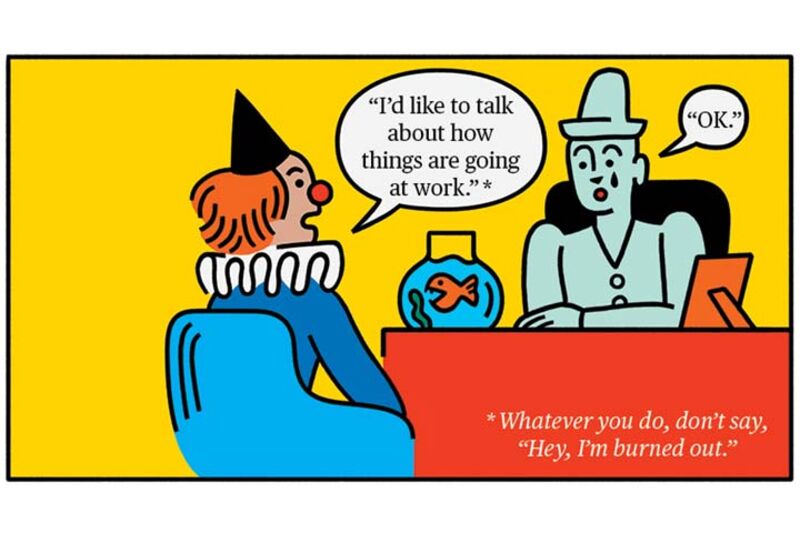
How to Tell HR You Have It

Let Steve Browne, executive director of human resources for Cincinnati-based pizza chain LaRosa’s and a speaker on human-resources-related issues, help you role-play.
The OpeningSchedule the talk before or after work or during lunch, Browne says—not while you should be working.
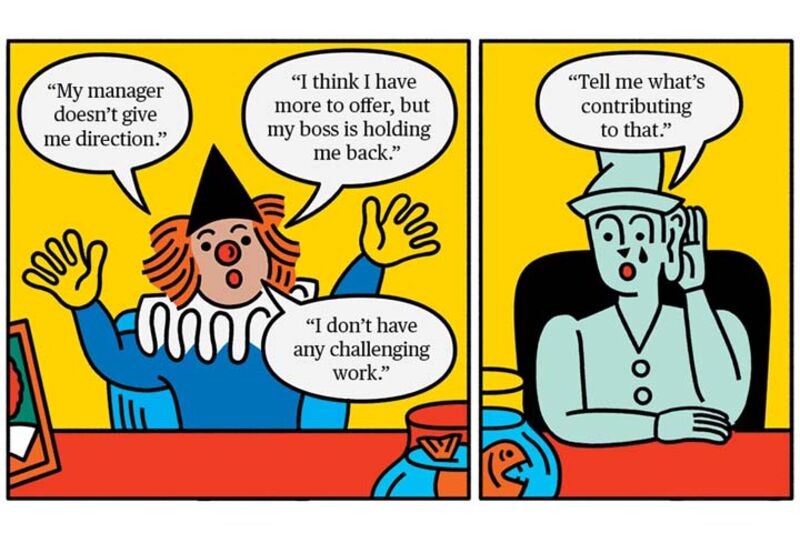
ILLUSTRATOR: TOMI UM FOR BLOOMBERG BUSINESSWEEK
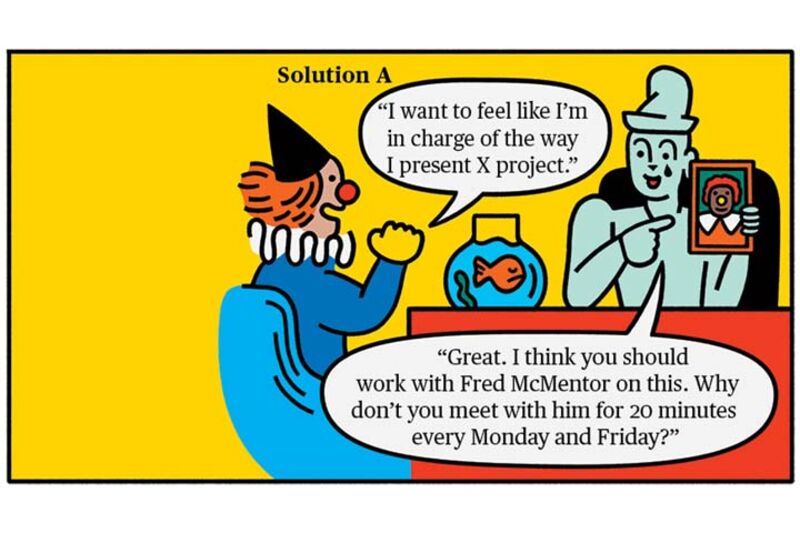
The PitchAt this point, if you want to keep your job, you should have a solution at hand: “You want to say, ‘This is the situation, and this is what I’m thinking,’ ” Browne says. “That’s a much better conversation than, ‘Everything is messed up.’ ” 
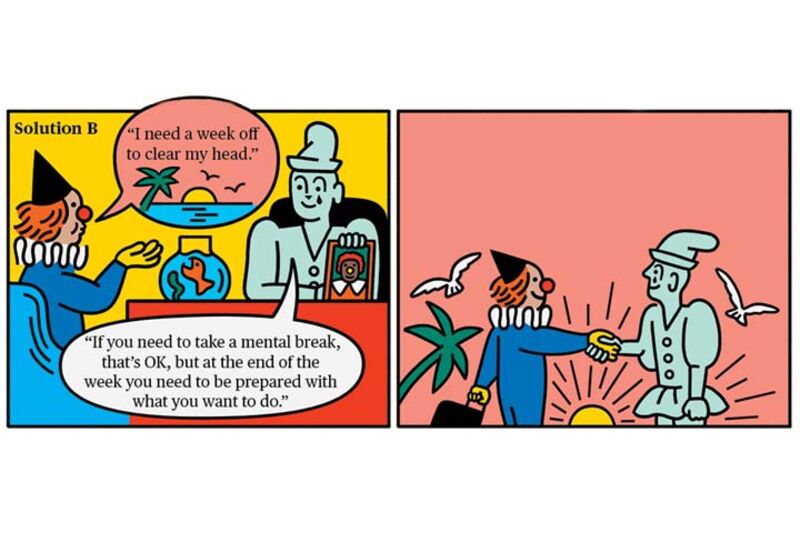
ILLUSTRATOR: TOMI UM FOR BLOOMBERG BUSINESSWEEK
The CloserYou and your HR rep should both be satisfied with the plan you develop and ready to give it an honest chance. If that doesn’t work, Browne says, start thinking about whether this is really the right job for you.

Managers: Stop It Before It Starts

ILLUSTRATOR: TOMI UM FOR BLOOMBERG BUSINESSWEEK
Mandatory group work. Every week, the California-based product design company Zurb Inc. hosts the “Friday15,” bringing employees together to solve a creative challenge in 15 minutes. They might design a company logo or play a quick game of capture the flag—the idea is to build up a feeling of trust and teamwork, but it also helps people blow off steam after a long week.
Time for your own projects. Many places go beyond Google Inc.’s famous 20 percent time policy, which allowed employees to work on projects not directly related to their job. (Google killed the policy in 2013.) The Brooklyn ad agency Huge, for instance, holds regular hackathons for employees with a panel of judges who pick the most promising idea. Winners get funding and office space for their projects—and Huge gets an ownership stake.
ILLUSTRATOR: TOMI UM FOR BLOOMBERG BUSINESSWEEK
Communication blackouts. Whenever an employee at Bandwidth.com Inc., a communications-technology company in Raleigh, N.C., goes on vacation, the entire staff is notified, so they’ll avoid bugging the vacationer with email while they’re away. That way, the employee gets an actual vacation and isn’t tempted to check in.
Sponsored pampering. Johnson & Johnson recently started the Premier Executive Leadership Program, a nine-month, $100,000 plan to stave off burnout among the muckety-mucks at J&J and other companies. Participants are assigned an executive coach, a nutritionist, and a physiologist who work together to make sure the executive stays in top form.

Tuesday, December 26, 2017

Six Habits Of People Who Know How To Bring Out The Best In Others

Six Habits Of People Who Know How To Bring Out The Best In Others

As a leader, the most important part of your job isn’t your results. Your job is to inspire your employees’ results. Here’s how.

Six Habits Of People Who Know How To Bring Out The Best In Others
[PHOTO: FLICKR USER ANDREW FOGG]
If you think your most important job as a leader is to write mission statements, set goals, or even increase revenue, you’re focusing on the wrong metrics. Your most significant role doesn’t involve your results; your job is to inspire your employees’ results, says Richard S. Wellins, co-author of Your First Leadership Job: How Catalyst Leaders Bring Out the Best In Others.
“As a leader your focus changes; your number one priority is to bring out the best in others,” says Wellins, who is senior vice president at management consulting firm DDI.
study done by DDI and Harris Interactive found that 98% of employees who have good leaders are motivated to do their best, while only 11% of employees with ineffective managers felt motivated to give their best.
Being able to bring out the best in others is a skill that involves just 10% natural inclination; the other 90% has to be deliberate, says Wellins: “It can’t be learned by listening to a lecture or reading examples,” he says. “It needs to be practiced, reinforced, and used day to day.”
Here are six of their daily habits:

1. THEY FOCUS ON THE PERSON’S STRENGTHS

Good leaders identify the strengths of individual team members and give employees opportunities to use them, says Wellins. “They cultivate and optimize others’ talents and capabilities,” he says.
While some strengths will be obvious, good leaders schedule one-on-one meetings and ask questions such as, “What do you enjoy doing most as part of your work?” and “What do you miss most about the jobs you’ve had in the past and why?”

2. THEY EMPATHIZE

Leaders who bring out the best in others listen to what team members are saying and put themselves in their shoes, says Wellins. When dealing with an emotional situation, listening and responding with empathy can immediately reduce tension, and until things calm down, nothing productive can occur.
“Empathy will drive better performance; this is a huge motivator,” says Wellins.

3. THEY GIVE RECOGNITION

People who bring out the best in others also reward and recognize good work. Leaders often worry that praise will seem unprofessional or that employees will become complacent or overconfident.
“It isn’t and they won’t,” says Wellins. “It’s about making a person feel good about themselves even when they feel challenged or are in tough times..”
This is also important when things are going well, adds Wellins. “It’s so simple, but our research shows that one- to two-thirds of leaders are not good at acknowledging good work,” he says.

4. THEY CONNECT THE RIGHT PEOPLE

Liz Wiseman, author of Rookie Smarts: Why Learning Beats Knowing in the New Game of Work, calls leaders who bring out the best in others “multipliers.” She says multipliers look for talent everywhere and focus on finding people, at whatever level, who know the things they don’t.
“Multipliers take the time to understand the capabilities of each individual so that they can connect employees with the right people and the right opportunities—thereby building a virtuous cycle of attraction, growth, and opportunity,” she writes in an article for Harvard Business Review.

5. THEY DON’T MICROMANAGE

Bringing out the best in others means delegating. “Good managers are careful to not micromanage,” says Wellins. “Their job is to assign or direct general goals in work that needs to be done but they should never do it for the person.”
Stretch goals that push people can have a big impact on how people feel about themselves, their work, and what they can accomplish, says Wellins. “Appeal to their strengths and give them responsibility and they will achieve their goals,” he says.
As team members earn small wins, their confidence grows and seemingly insurmountable problems appear less daunting, adds Wiseman; roadblocks become interesting puzzles for the team to solve.
“Multipliers see themselves as coaches and teachers,” writes Wiseman. “These leaders put a high premium on self-sufficiency: Once they delegate a task or decision, they don’t try to take it back.”

6. THEY CREATE SAFE ENVIRONMENTS

People who bring out the best in others give people permission to think, speak, and act with reason, says Wiseman.
“They generate an intensity that demands high-level work from the team, but they also have a high tolerance for mistakes and understand the importance of learning along the way,” she writes. “So they create mental spaces in which people can flourish.”

Friday, December 8, 2017

9 common-sense rules for getting the most out of meetings

9 common-sense rules for getting the most out of meetings

Dec 5, 2017 

Veteran financier Ray Dalio has been in every kind of meeting: the good, the bad and the ugly. Here’s how he keeps his meetings focused and productive.

In 1974, Ray Dalio founded the hedge fund Bridgewater Associates, and it’s now the world’s largest, managing roughly $160 billion. Besides its financial success, Bridgewater has become known for creating a unique culture of radical truth and radical transparency. Here is Dalio’s advice for how to run meetings that don’t go off the rails.
1. Make it clear who is directing the meeting and who it is meant to serve.Every meeting should be aimed at achieving someone’s goals; that person is the one responsible for the meeting and decides what they want to get out of it and how they will do so. Meetings without someone clearly responsible run a high risk of being directionless and unproductive.
2. Make clear what type of communication you are going to have in light of the objectives and priorities. If your goal is to have people with different opinions work through their differences to try to get closer to what is true and what to do about it (i.e., open-minded debate), you’ll run your meeting differently than if its goal is to educate. Debating takes times, and that time increases exponentially depending on the number of people participating in the discussion, so you have to carefully choose the right people in the right numbers to suit the decision that needs to be made. In any discussion, try to limit the participation to those whom you value most in your objectives. The worst way to pick people is based on whether their conclusions align with yours. Group-think (people not asserting independent views) and solo-think (people being unreceptive to the thoughts of others) are both dangerous.
3. Lead the discussion by being assertive and open-minded. Reconciling different points of view can be difficult and time-consuming. It is up to the meeting leader to balance conflicting perspectives, push through impasses and decide how to spend time wisely. A common question I get is: What happens when someone inexperienced offers an opinion? If you’re running the conversation, you should be weighing the potential cost in the time that it takes to explore their opinion versus the potential gain in being able to assess their thinking and gain a better understanding of what they’re like. Exploring the views of people who are still building their track record can give you valuable insights into how they might handle new responsibilities. Time permitting, you should work through their reasoning with them so they can understand how they might be wrong. It’s also your obligation to open-mindedly consider whether they’re right.
4. Watch out for “topic slip.” Topic slip is random drifting from topic to topic without achieving completion on any of them. One way to avoid is by tracking the conversation on a whiteboard so that everyone can see where you are.
5. Enforce the logic of conversations. People’s emotions tend to heat up when there is a disagreement. Remain calm and analytical at all times; it is more difficult to shut down a logical exchange rather than an emotional one. Remember, too, that emotions can shade how people see reality. For example, people will sometimes say, “I feel like (something is true)” and proceed as though it’s a fact, when other people may interpret the same situation differently. Ask them, “Is it true?” to ground the conversation in reality.
6. Be careful not to lose personal responsibility via group decision making.Too often, groups will make a decision to do something without assigning personal responsibilities, so it is not clear who is supposed to follow up by doing what. Be clear in assigning personal responsibilities.
7. Utilize the “two-minute rule” to avoid persistent interruptions. The two-minute rule specifies that you have to give someone that uninterrupted period to explain their thinking before jumping in with your own. This ensures everyone has time to fully crystallize and communicate their thoughts without worrying they will be misunderstood or drowned out by a louder voice.
8. Watch out for assertive “fast talkers.” Fast talkers say things faster than they can be assessed, as a way of pushing their agenda past other people’s examination or objections. Fast talking can be especially effective when it’s used against people worried about appearing stupid — don’t be one of those people. Recognize that it’s your responsibility to make sense of things, and don’t move on until you do. If you’re feeling pressured, say something like, “Sorry for being stupid, but I’m going to need to slow you down so I can make sense of what you’re saying.” Then, ask your questions. All of them.
9. Achieve completion in conversations. The main purpose of a discussion is to achieve completion and get in sync, which leads to decisions and/or actions. Conversations that fail to reach completion are a waste of time. When there is an exchange of ideas, it is important to end it by stating the conclusions. If there is agreement, say it; if not, say that. When further action has been decided, get those tasks on a to-do list, assign people to do them, and specify due dates. Write down your conclusions, working theories and to-do’s in places that will lead to their being used as foundations for continued progress. To make sure this happens, assign someone to make sure notes are taken and follow-through occurs.
Excerpted from the new book Principles: Life and Work by Ray Dalio. Copyright © 2017 by Ray Dalio. Used with permission of Simon & Schuster, New York. All rights reserved.